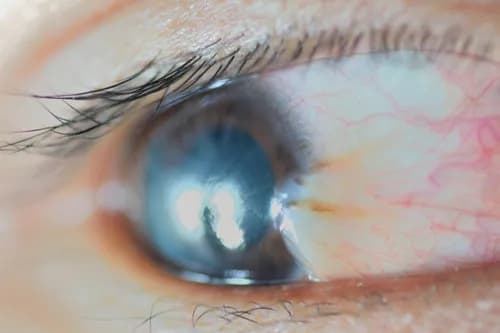
Tumors of the eye can either be benign (non-cancerous) or malignant (cancerous). There are certain tumors that are classified as atypical (uncertain or unspecified behavior) meaning that some behave in a benign manner, or some behave in a malignant manner. A majority of the eye tumors diagnosed via lab studies (biopsy) are benign.
Eye tumors may involve the anatomical regions of conjunctiva and caruncle, uveal tract (iris, ciliary body, and choroid), retina and neuroepithelium, optic disc and optic nerve, lacrimal gland and lacrimal drainage system.
The World Health Organization (WHO) is an authoritative body that compiles, prepares, and publishes histological and molecular classification of tumors, via their Blue Books, based on research inputs from experts worldwide. These reference books chiefly aid in global cancer research, provide gold standards for tumor diagnosis, and help in treating cancer patients.
According to the WHO Classification of Tumors of the Eye (2018), 4th Ed., Vol. 12, benign and malignant tumors of the eye are classified in the following manner:
Tumors of the conjunctiva and caruncle:
Epithelial tumors
- Conjunctival squamous papilloma
- Oncocytoma
- Keratoacanthoma
- Hereditary benign intraepithelial dyskeratosis of the conjunctiva
- Conjunctival squamous intraepithelial neoplasia
- Conjunctival squamous cell carcinoma
- Conjunctival spindle cell carcinoma
- Adenosquamous carcinoma
- Sebaceous carcinoma
Tumor-like lesions, hamartomas and choristomas
- Cysts
- Reactive epithelial hyperplasia
- Pseudoglandular and pseudoepitheliomatous hyperplasia
- Epibulbar choristoma
- Epibulbar osseous choristoma
- Phakomatous choristoma
Melanocytic tumors
- Benign epithelial melanoses of the conjunctiva
- Conjunctival junctional, compound, and subepithelial nevi
- Inflamed juvenile conjunctival nevus
- Blue nevus of the conjunctiva
- Spitz nevus of the conjunctiva
- Conjunctival melanocytic intraepithelial neoplasia
- Conjunctival melanoma
Tumors metastatic to the conjunctiva
Tumors of the uveal tract:
Tumors of the iris
- Ocular melanocytosis
- Lisch nodule
- Melanocytic nevus
- Iris melanoma
- Implantation cyst
- Ectopic lacrimal gland
Tumors of the ciliary body and choroid
- Choroidal and ciliary body nevi
- Uveal melanocytoma
- Bilateral diffuse uveal melanocytic hyperplasia
- Choroidal and ciliary body melanomas
Tumors metastatic to the uveal tract
Tumors of the retina and neuroepithelium:
Tumors of the neurosensory retina
- Retinocytoma
- Retinoblastoma
- Astrocytic hamartoma and astrocytoma
- Nodular and massive retinal gliosis
- Tumors metastatic to the retina
Tumors of the retinal pigment epithelium
- Congenital hypertrophy of the retinal pigment epithelium
- Simple and combined hamartomas of the retinal pigment epithelium
- Reactive hyperplasia of the retinal pigment epithelium
- Adenoma of the retinal pigment epithelium
- Adenocarcinoma of the retinal pigment epithelium
Tumors of the iris and ciliary body neuroepithelium
- Pigmented epithelial cyst of the iris
- Adenomatous hyperplasia of the ciliary body
- Reactive epithelial hyperplasia of the ciliary body
- Ciliary body adenoma
- Adenocarcinoma of the ciliary body
- Medulloepithelioma of the ciliary body
- Glioneuroma of the ciliary body
Tumors of the optic disc and optic nerve:
Primary tumors
- Melanocytoma of the optic disc and optic nerve
- Medulloepithelioma of the optic disc and optic nerve
- Astrocytoma and glioblastoma of the optic disc and optic nerve
- Meningioma of the optic nerve
Tumors metastatic to the optic nerve
Tumors of the lacrimal gland:
Epithelial tumors
- Pleomorphic adenoma
- Oncocytic tumors
- Myoepithelial tumors
- Carcinoma ex pleomorphic adenoma
- Adenoid cystic carcinoma
- Adenocarcinoma
- Mucoepidermoid carcinoma
- Carcinosarcoma
Rare neoplasms
- Epithelial myoepithelial carcinoma
- Low-grade intraductal carcinoma
- Secretory carcinoma
- Hybrid neoplasms
- Acinic cell carcinoma
- Warthin tumor
Tumors metastatic to the lacrimal gland
Tumors of the lacrimal drainage system:
Epithelial tumors
- Exophytic papilloma
- Inverted papilloma
- Squamous cell carcinoma
- Non-keratinizing squamous cell carcinoma
- Adenocarcinoma
- Mucoepidermoid carcinoma
- Adenoid cystic carcinoma
- Lymphoepithelial carcinoma
Other tumors
- Melanoma
- Tumors metastatic to the lacrimal drainage system
Hematolymphoid tumors:
Hematolymphoid tumors of conjunctiva
- Papillary/follicular conjunctivitis
- Reactive lymphoid hyperplasia
- Juvenile xanthogranuloma
- Lymphomas
Hematolymphoid tumors of the uveal tract
- Histiocytic tumors
- Primary choroidal lymphoma
- Involvement of the choroid by systemic lymphoma
- Leukemic infiltration
Hematolymphoid tumors of the retina
- Vitreoretinal lymphoma
- Leukemic infiltration
Hematolymphoid tumors of lacrimal gland and drainage system
- Reactive lymphoid hyperplasia
- Lymphomas of lacrimal gland
- Lymphomas of lacrimal sac
Mesenchymal Tumors:
Fibroblastic and myofibroblastic tumors
- Conjunctival stromal tumor
- Myxoma of the conjunctiva and caruncle
- Fibrous histiocytoma of the conjunctiva and caruncle
- Solitary fibrous tumor/hemangiopericytoma of the optic nerve sheath
Vascular Tumors
- Hemangiomas of the conjunctiva, uveal tract and retina
- Lymphangioma of the conjunctiva and caruncle
- Kaposi sarcoma of the conjunctiva and caruncle
- Angiosarcoma of the conjunctiva and caruncle
- Hemangioblastoma of the retina
Smooth-muscle tumors
- Leiomyoma of the ciliary body
- Leiomyosarcoma of the conjunctiva and caruncle
Skeletal muscle tumors
- Rhabdomyosarcoma of the conjunctiva and caruncle
Peripheral nerve sheath tumors
- Neurofibroma and ganglioneuroma
- Schwannoma
Tumors of uncertain derivation
- Osteoma
Additional eye tumor articles (on DoveMed) that are not part of WHO Classification of Tumors of the Eye:
Hemangioma of the Eye: It affects the eye and surrounding structures including the eyelid and orbit. Most tumors are observed in infants and young children. Hemangiomas are benign malformation of blood vessels.
Hidradenoma of Eyelid is a very rare, benign tumor of the sweat glands. It is often seen in middle-aged or older adults and may be present on the lower or upper eyelid.
Hidradenoma Papilliferum of Eyelid is a slow-growing and usually solitary tumor that occurs as a painless papule or mass. It is a very rare condition that is seen in the eyelid of middle-aged women.
Lymphoma of Eye: It is an uncommon lymphoma that is generally observed in elderly adults. The condition may affect the conjunctiva, inside structure of eye, eyeball, or tissues around the eye orbit.
Ocular MALT Lymphoma: It is a rare non-gastric type of extranodal marginal zone lymphoma. It can affect any part of the eye, such as the conjunctiva, inside structure, or globe of the eye, of older adults. The condition is also known as Marginal Zone Lymphoma of Eye.
Ocular Melanoma: When melanoma develops from the melanocytes in the eye it is called Ocular Melanomas. In adults, this is the most common primary cancer of the eye.

Related Articles
Test Your Knowledge
Asked by users
Related Centers
Related Specialties
Related Physicians
Related Procedures
Related Resources
Join DoveHubs
and connect with fellow professionals
0 Comments
Please log in to post a comment.