What are the other Names for this Condition? (Also known as/Synonyms)
- Carpal Navicular Fracture
- Open Fracture of Navicular Bone of Wrist
- Open Fracture of Scaphoid Bone of Wrist
What is Scaphoid Fracture of the Wrist? (Definition/Background Information)
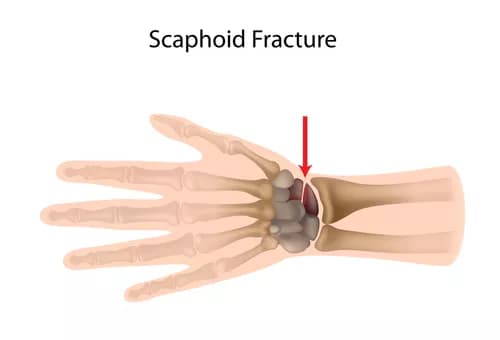
- The scaphoid bone is one of the 8 carpal bones of the wrist, located on the thumb side of the wrist. A Scaphoid Fracture is an injury to the scaphoid bone of the wrist
- Scaphoid Fractures are usually caused by high-energy impacts resulting from an athletic sport, a motor vehicle accident, or a fall from a substantial height
Who gets Scaphoid Fracture of the Wrist? (Age and Sex Distribution)
- Scaphoid Fractures of the Wrist are non-specific fractures, and as such, may occur in individuals of any age, race, ethnic group, and gender
- Even though only a small percentage of all wrist fractures occur to the scaphoid bone, young adults, who are physically active, have the highest risk of sustaining this injury
- Men are more likely to experience a Scaphoid Fracture, than women
What are the Risk Factors for Scaphoid Fracture of the Wrist? (Predisposing Factors)
There are many factors that increase the possibility of sustaining a Scaphoid Fracture of the Wrist, such as certain types of medical conditions, and increased physical activity. Risk factors associated with a Scaphoid Fracture include:
- Participation in high-risk contact sports, such as football or basketball
- Degenerative bone disease (osteoporosis)
It is important to note that having a risk factor does not mean that one will get the condition. A risk factor increases ones chances of getting a condition compared to an individual without the risk factors. Some risk factors are more important than others.
Also, not having a risk factor does not mean that an individual will not get the condition. It is always important to discuss the effect of risk factors with your healthcare provider.
What are the Causes of Scaphoid Fracture of the Wrist? (Etiology)
A few causal factors associated with a Scaphoid Fracture in the Wrist include:
- Falling from a significant height; especially landing on one’s hands (or the fracture occurring since the individual is overweight)
- Direct trauma to the wrist due to an automobile accident
- Taking part in any rough or high-impact sport
What are the Signs and Symptoms of Scaphoid Fracture of the Wrist?
Signs and symptoms of a Scaphoid Fracture of the Wrist include:
- Sharp pain at the site, where the injury occurred
- Difficultly with hand or thumb/finger movement, weakness
- Swelling, tenderness to touch
- Limited range of wrist motion
- Difficultly gripping objects
How is Scaphoid Fracture of the Wrist Diagnosed?
Diagnostic methods that a physician may use to help diagnose a Scaphoid Fracture of the Wrist include:
- Physical examination: A thorough physical examination is important in identifying any noticeable deformities, swelling, contusions, in the wrist. Individuals are also expected to provide an explanation of the circumstances that caused the injury. In addition to this, a complete medical history can aid in arriving at a definitive diagnosis
- X-ray: X-rays are the most common method in evaluating a fracture, if the bone has been displaced. This diagnostic test helps provide a clear image of the bone, identify the exact location of the injury, and determine the extent of the fracture
- Computerized tomography (CT) scan: A CT scan takes a series of x-ray images from several different angles. These images are then merged to create cross-sectional images of bones and soft tissues of the body, which then allows a physician to examine the wrist and surrounding structures
- Magnetic resonance imaging (MRI): An MRI is a more detailed scan that uses radio waves and a magnetic field to generate thorough images of the interior bones and soft tissues
- Bone Scan: A bone scan is a diagnostic method used to identify any bone abnormalities. It is performed by injecting tiny amounts of radioactive material into the bloodstream
Many clinical conditions may have similar signs and symptoms. Your healthcare provider may perform additional tests to rule out other clinical conditions to arrive at a definitive diagnosis.
What are the possible Complications of Scaphoid Fracture of the Wrist?
Complications associated with a Scaphoid Fracture of the Wrist include:
- Degenerative joint disease (osteoarthritis)
- Osteonecrosis: A serious disorder characterized by a temporary or permanent disruption of blood flow to the bones
- Prolonged and chronic pain
- Infection of the bone (osteomyelitis)
- Permanent disability, or abnormal deformity of the wrist
How is Scaphoid Fracture of the Wrist Treated?
A high percentage of Scaphoid Fractures of the Wrist require surgery. However, this injury may also be treated non-surgically. The nonsurgical treatment methods include:
- Any activity that aggravates the wrist condition should be avoided. The physician may advise the individual to refrain from participating in any physical activities, till the pain or symptoms get better
- Applying ice to the wrist/hand can help reduce pain and swelling
- Complete immobilization of the wrist with a cast, may be required to restrict movement
- Non-steroidal anti-inflammatory oral medications, such as indomethacin and naproxen, may be used to treat a Scaphoid Fracture. These medications can help decrease the pain and swelling
- Individuals are likely to need physical therapy exercises after the cast is removed. The goals of these exercises are to strengthen the wrist muscles, improve flexibility, and decrease stiffness. It may take several months for an individual to complete the physical therapy program and regain full strength and functionality
Surgical treatment methods include:
- Closed reduction: Closed reduction is a surgical method that involves realigning the scaphoid bone back to its original position, without making an incision at the fracture site. This procedure is typically performed under conscious sedation, or general anesthesia with muscle relaxants
- Open reduction and internal fixation (ORIF): Open reduction is a surgical procedure to realign the fractured bone, to its original position. Surgical hardware (such as plates, screws, or rods) is then used to stabilize the fractured bone under the skin
How can Scaphoid Fracture of the Wrist be Prevented?
To prevent a Scaphoid Fracture, individuals should be careful and consciously aware, while performing any physical activities, such as sports, or even some normal daily activities that could lead to situations involving accidents. Children must be provided a safe environment to work, study, or play. Any possible dangers should also be anticipated and appropriate safety measures adopted.
A few ways to further help prevent unwanted injuries or a Scaphoid Fracture include:
- Individuals who participate in any high-risk sports, should wear appropriate safety equipment to help prevent the possibility of such fractures
- Consuming foods rich in calcium, such as milk, yogurt, and cheese, help build bone strength. Regular diet with appropriate calcium-intake is recommended, even after a Scaphoid Fracture. For women, the recommended amount of calcium, increases with age and menopause
- Perform weight-bearing exercises to strengthen bones
What is the Prognosis of Scaphoid Fracture of the Wrist? (Outcomes/Resolutions)
- A high percentage of Scaphoid Fracture heal without any serious complications
- A full recovery and a return to sports or normal daily activities usually requires 4-12 weeks, depending on the severity of the fracture
- When properly treated and rehabilitated, usually under the guidance of a physiotherapist/specialist, a high percentage of individuals regain their full strength and range of motion in the injured wrist
Additional and Relevant Useful Information for Scaphoid Fracture of the Wrist:
The following DoveMed website link is a useful resource for additional information:

Related Articles
Test Your Knowledge
Asked by users
Related Centers
Related Specialties
Related Physicians
Related Procedures
Related Resources
Join DoveHubs
and connect with fellow professionals
0 Comments
Please log in to post a comment.