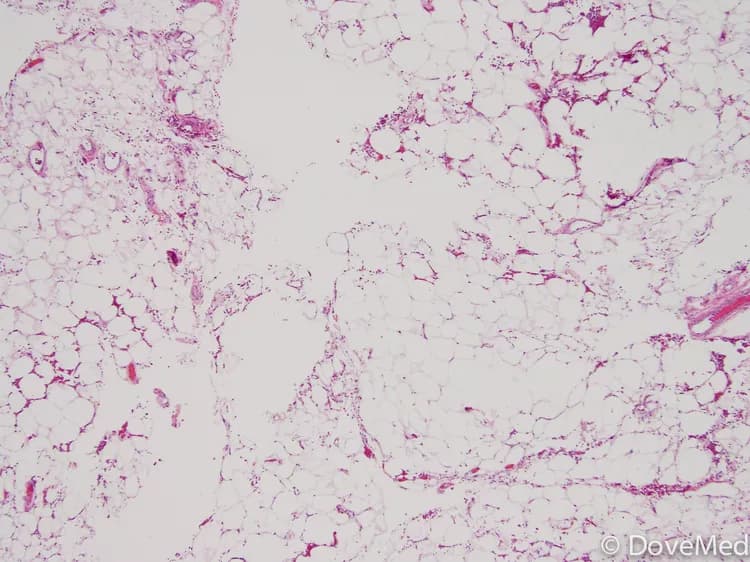
What are the other Names for this Condition? (Also known as/Synonyms)
- Lipoma of Small Bowel
- Small Bowel Lipoma
- Small Intestinal Lipoma
What is Lipoma of Small Intestine? (Definition/Background Information)
- Lipoma of Small Intestine is a common benign tumor that forms in the small bowel. A lipoma is seen among a wide range of adults and can occur at various locations in the body
- In general, the cause and predisposing factors for formation of Lipoma of Small Intestine is unknown
- Small-sized tumors are not known to cause any significant symptoms, but larger tumors may lead to abdominal discomfort and compression of adjoining organs
- A complete surgical removal of the lesion results in a cure. The prognosis of Lipoma of Small Intestine is excellent with treatment, especially when they are small
Who gets Lipoma of Small Intestine? (Age and Sex Distribution)
- Lipoma of Small Intestine is seen in a wide age group of individuals, but is more often observed in adults (age group 50-60 years). Children are very rarely affected
- Both males and females are affected
- All races and ethnic groups are at risk for tumor development
- It is the 3rd most common benign tumor of the small intestine
What are the Risk Factors for Lipoma of Small Intestine? (Predisposing Factors)
- Currently, no definitive risk factors for Lipoma of Small Intestine are known
It is important to note that having a risk factor does not mean that one will get the condition. A risk factor increases one’s chances of getting a condition compared to an individual without the risk factors. Some risk factors are more important than others.
Also, not having a risk factor does not mean that an individual will not get the condition. It is always important to discuss the effect of risk factors with your healthcare provider.
What are the Causes of Lipoma of Small Intestine? (Etiology)
The exact cause of formation of Lipoma of Small Intestine is unknown.
What are the Sign and Symptoms of Lipoma of Small Intestine?
Small-sized Lipoma of Small Intestine may not cause any significant symptoms and are detected incidentally. In others, the following signs and symptoms may be noted:
- Abdominal discomfort and pain
- Most tumors are small-sized, while some may grow to large sizes
- Lipomas are often well-defined and demarcated; some tumors are located on the surface (mucosal), while others may involve the deep tissue layers
- The tumors may be located anywhere in the small intestine; however, the ileum is the most common site of a lipoma within the GI tract
- Intussusception: When one part of the intestine pushes itself into another part of the intestine (telescoping), causing obstruction of the bowel
- Narrowing of the intestine
- Tumors may rarely ulcerate and bleed; blood in stool
How is Lipoma of Small Intestine Diagnosed?
A diagnosis of Lipoma of Small Intestine may be undertaken using the following tests and exams:
- Complete evaluation of family (medical) history, along with a thorough physical examination
- Stool sample analysis
- X-ray of the abdomen and pelvic region
- Barium enema X-ray
- Endoscopy for tumors in the duodenum (upper part of the small intestine). Capsule endoscopy is an effective tool for observing the small intestine along its entire length
- CT or MRI scan of the abdomen and pelvic region: CT scan with contrast or enteroclysis is a reliable procedure for diagnosing the tumor
- Abdominal ultrasound scan
- Upper GI endoscopy: An endoscopic procedure is performed using an instrument called an endoscope, which consists of a thin tube and a camera. Using this technique, the radiologist can have a thorough examination of the insides of the gastrointestinal tract
- Screening colonoscopy: A typical colonoscopy involves using a thin, flexible tube (called a colonoscope), with an attached video camera, to view the colon and rectum. It may help view the ileal and jejunal portions too
- Tissue biopsy of the tumor:
- A tissue biopsy of the tumor is performed and sent to a laboratory for a pathological examination. A pathologist examines the biopsy under a microscope. After putting together clinical findings, special studies on tissues (if needed) and with microscope findings, the pathologist arrives at a definitive diagnosis. Examination of the biopsy under a microscope by a pathologist is considered to be gold standard in arriving at a conclusive diagnosis
- Biopsy specimens are studied initially using Hematoxylin and Eosin staining. The pathologist then decides on additional studies depending on the clinical situation
- Sometimes, the pathologist may perform special studies, which may include immunohistochemical stains, molecular testing, and very rarely, electron microscopic studies to assist in the diagnosis
Many clinical conditions may have similar signs and symptoms. Your healthcare provider may perform additional tests to rule out other clinical conditions to arrive at a definitive diagnosis.
What are the possible Complications of Lipoma of Small Intestine?
Some potential complications of Lipoma of Small Intestine include:
- Intussusception, requiring surgical correction
- Emotional and psychological stress due to cancer diagnosis
- Obstruction of the small intestine by large tumor masses
- Some tumors are known to perforate the small bowel
- Recurrence of the tumor after treatment, especially due to partial surgical removal
- Side effects due to cancer therapy
How is Lipoma of Small Intestine Treated?
Due to the benign (non-cancerous) nature of Lipoma of Small Intestine, small-sized tumors do not generally require any treatment. However, since most small intestine tumors are malignant, these tumors (lipomas) may be removed to confirm the diagnosis.
- In some cases, the healthcare provider may recommend a ‘wait and watch’ approach for small-sized tumors, after diagnosis of the tumor is confirmed
- A complete surgical resection of the tumor is usually curative. It is normally undertaken when significant symptoms are observed
Regular observation and periodic checkups to monitor the condition is recommended following treatment.
How can Lipoma of Small Intestine be Prevented?
Presently, there are no specific methods or guidelines to prevent the formation of Lipoma of Small Intestine.
What is the Prognosis of Lipoma of Small Intestine? (Outcomes/Resolutions)
- The prognosis for individuals with Lipoma of Small Intestine is generally excellent in a majority of individuals, since it is a benign tumor
- Typically, individuals with small-sized tumors have a better prognosis than those with larger-sized tumors
Additional and Relevant Useful Information for Lipoma of Small Intestine:
The following article link will help you understand other cancers and benign tumors:

Related Articles
Test Your Knowledge
Asked by users
Related Centers
Related Specialties
Related Physicians
Related Procedures
Related Resources
Join DoveHubs
and connect with fellow professionals
0 Comments
Please log in to post a comment.