Novel Technology Designed To Increase MRI Speeds
Nicholas Dwork, PhD, assistant professor in the Department of Biomedical Informatics at the University of Colorado School of Medicine, has filed a provisional patent for a technology that could increase scan speeds of three-dimensional magnetic resonance imaging (MRI). The invention could lead to faster results, increase the clinical applications of MRIs, and ultimately improve patient care.
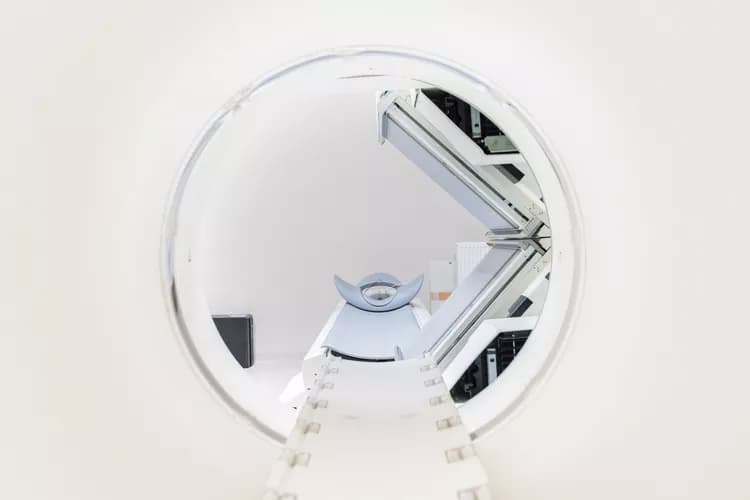
Complex mathematics and engineering are involved in generating images of internal organs and tissues when patients enter the magnetic tube of an MRI machine. Any movement by the patient can corrupt the images, and the scan can take an hour or longer. During this time, the machine makes loud noises as radio waves reverberate off bodily structures to create images. Because the field of view – the part of space that is imaged – is typically rectangular, the radio waves also bounce off areas outside the body. This is where Dwork’s technology comes into play.
“Suppose you knew nothing at all about the image you were trying to make,” Dwork says. “In that case, you would need a maximum amount of information in order to make the image, which means collecting a maximum amount of data. How can we reduce the amount of data we need? If we had more information about the picture we were making, then we wouldn't need as much data.”
His method adjusts the sampling pattern created by the machine’s magnetic fields.
“They’re called pulse sequence diagrams,” Dwork explains. “Think of the MRI as a musical instrument. Much like a musical instrument, they can play different songs. You might think of it as sheet music for the MRI machine.”
He collaborated with faculty in the Department of Radiology to develop applications for the programming and will continue to refine the technology through his own research.
“Primarily, this means combining this particular method of making MRI faster with other technologies to make scanning extremely fast,” he says. “These other technologies include what is known as partial Fourier sampling, parallel imaging, compressed sensing, and deep learning.”
Dwork estimates that his approach to MRI scans could reduce times by about 25 percent, enabling doctors to get results faster and reducing patients’ time in the MRI tube. He envisions the faster scans being used for a multitude of purposes, potentially expanding MRI use to very young children and pregnant patients. He hopes to research its application to twin-to-twin transfusion syndrome, a rare condition in which twin fetuses share one placenta and a network of blood vessels. A fast, accurate MRI can guide a surgeon in cauterizing the blood vessels in the placenta to address the condition and improve outcomes for the fetuses.
Dwork, who has focused on applying advanced mathematics to medical problems throughout his career, says his work wouldn’t be possible without the support he’s found at CU. As a member of the Affiliate Faculty Program of the Applied Mathematics Department at CU Boulder, he gives presentations on medical problems to the math department while also bringing novel mathematical insights to CU Anschutz Medical Campus. He's also working with CU Innovations, the technology commercialization and venture development office at CU Anschutz, to market the invention to imaging companies and developing research in the clinical setting.
“For the type of work that I like to do, which is applying advanced mathematics to medical problems, CU Anschutz is the perfect place to be,” he says. “I'm extremely grateful to the Department of Biomedical Informatics for giving me this professional opportunity and providing me with so many resources to maximize the probability of my success.”

Related Articles
Test Your Knowledge
Asked by users
Related Centers
Related Specialties
Related Physicians
Related Procedures
Related Resources
Join DoveHubs
and connect with fellow professionals
0 Comments
Please log in to post a comment.