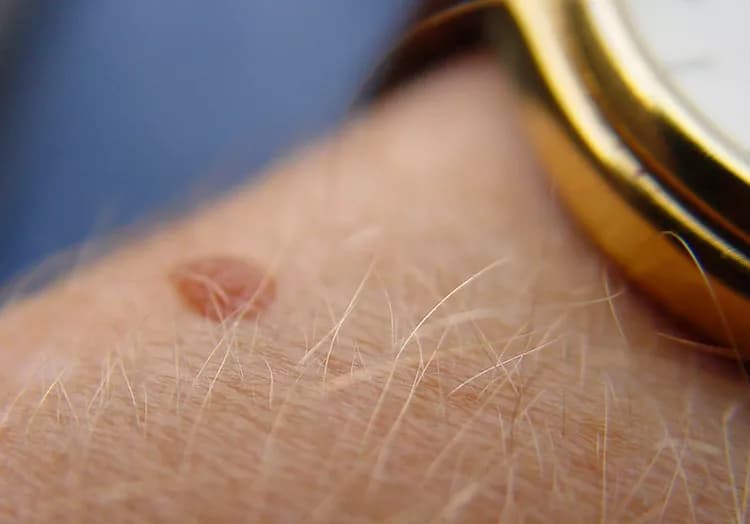
New Insight On Mole Growth Could Aid Development Of Skin Cancer Treatments
Moles stop growing when they reach a certain size due to normal interactions between cells, despite having cancer-associated gene mutations, says a new study published today in eLife. The findings in mice could help scientists develop new ways to prevent skin cancer growth that take advantage of the normal mechanisms that control cell growth in the body.
Mutations that activate the protein made by the BRAF gene are believed to contribute to the development of skin cancer. However, recent studies have shown that these mutations do not often cause skin cancer, but instead result in the formation of completely harmless pigmented moles on the skin. In fact, 90% of moles have these cancer-linked mutations but never go on to form tumours. "Exploring why moles stop growing might lead us to a better understanding of what goes wrong in skin cancer," says lead author Roland Ruiz-Vega, a postdoctoral researcher at the University of California, Irvine, US.
Scientists believe that stress caused by rapid cell growth may stop the growth of moles through a process called oncogene-induced senescence (OIS), but this has not been proven. To test the idea, Ruiz-Vega and colleagues studied mice with BRAF mutations that develop numerous moles.
The team first focused on assessing 'senescence', a set of changes in cells usually associated with aging. Using a technique called single-cell RNA sequencing to compare mole cells with normal skin cells, they found that moles are growth-arrested, but no more senescent than normal skin cells. The cells also did not have any apparent differences in gene expression (where a gene is activated to create a necessary protein) that would support the idea of OIS controlling their growth.
Additionally, computer modelling of mole growth did not support the idea of OIS. In fact, the models suggested that mole cells communicate with each other when moles reach a certain size and stop growing. The same kind of communication also takes place in many normal tissues to enable them to achieve and maintain a correct size.
"Our results suggest that moles stop growing as a result of normal cell-to-cell communication, not as a response to stress from cancer genes, potentially changing the way we think about skin cancer," explains senior author Arthur Lander, Director of the Center for Complex Biological Systems, and Donald Bren Professor of Developmental and Cell Biology, at the University of California, Irvine. "This work paves the way for further research into the mechanisms that control skin cell growth, with the aim of better understanding what goes wrong to cause skin cancer and ultimately developing new treatments to help prevent the disease."

Related Articles
Test Your Knowledge
Asked by users
Related Centers
Related Specialties
Related Physicians
Related Procedures
Related Resources
Join DoveHubs
and connect with fellow professionals
0 Comments
Please log in to post a comment.