Anemia May Contribute To The Spread Of Dengue Fever
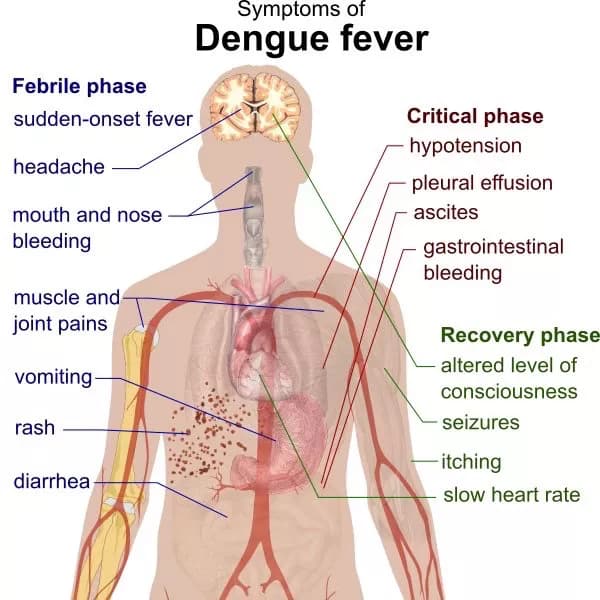
Mosquitoes are more likely to acquire the dengue virus when they feed on blood with low levels of iron, researchers report in the 16 September issue of Nature Microbiology. Supplementing people's diets with iron in places where both iron deficiency anemia and dengue fever are a problem could potentially limit transmission of the disease, but there are risks. Dengue fever is a disease spread by mosquitoes in the tropics, primarily Central America and northern South America, the Caribbean, sub-Saharan Africa and southeast Asia. It has also been transmitted in the southeastern US. Dengue causes a fever, rash, and terrible aches, and can also lead to shock and death. It causes about 60 million cases a year, with 18% requiring hospitalization and about 13,600 deaths, and costs about $9 billion annually worldwide.
Dengue is most commonly acquired in urban environments, and the expansion of cities in the tropics has been accompanied by an expansion in dengue infections. A vaccine exists, but it can actually make the disease worse if given to someone who has never been previously infected. Public health officials are actively looking for ways to reduce the prevalence of the disease.
UConn Health immunologist Penghua Wang wanted to see if blood quality had an impact on the spread of dengue virus. Blood levels of various substances can vary tremendously from person to person, even among healthy people. Wang and colleagues at Tsinghua University and State Key Laboratory of Infectious Disease Prevention and Control in Beijing, King Mongkut's Institute of Technology Ladkrabang in Bangkok, and the 920 Hospital Joint Logistics Support Force in Kunming ran a series of experiments to explore the idea.
They collected fresh blood from healthy human volunteers, then added dengue virus to each sample. Then they fed the blood to mosquitoes, and checked how many mosquitoes were infected from each batch. They found it varied quite a lot. And the variation correlated very closely with the level of iron in the blood.
"The more iron in the blood, the fewer mosquitoes were infected," says Wang. The team found it held true in a mouse model, too: mosquitoes feeding on mice infected with dengue were much more likely to acquire the virus if the mice were anemic.
The reason has to do with the mosquitoes' own immune systems. Cells in a mosquito's gut take up iron in the blood and use it to produce reactive oxygen. The reactive oxygen kills the dengue virus.
"In areas where dengue is endemic, iron deficiency is more common. It doesn't necessarily explain it, the high prevalence of dengue...but it could be possible that iron supplementation could reduce dengue transmission to mosquitoes in those areas," Wang says. But there's a big caveat.
Malaria tends to be common in the same areas as dengue. And plasmodium, the microorganism that causes malaria, thrives in an iron rich environment and might actually worsen if everyone is supplementing with iron. Public health authorities need to weigh the costs and benefits before embarking on any population-wide supplementation program.
In any case, Wang says, understanding how dengue is transmitted will help public health authorities and scientists develop new ways to control the disease, and hopefully similar viruses such as Zika and West Nile virus as well.
This research was funded by grants from the National Key Research and Development Plan of China, the National Natural Science Foundation of China, and Shenzen San-Ming Project for prevention and research on vector-borne diseases.

Related Articles
Test Your Knowledge
Asked by users
Related Centers
Related Specialties
Related Physicians
Related Procedures
Related Resources
Join DoveHubs
and connect with fellow professionals
0 Comments
Please log in to post a comment.