Amputees Can Learn To Control A Robotic Arm With Their Minds
A new study by neuroscientists at the University of Chicago shows how amputees can learn to control a robotic arm through electrodes implanted in the brain.
The research, published in Nature Communications, details changes that take place in both sides of the brain used to control the amputated limb and the remaining, intact limb. The results show both areas can create new connections to learn how to control the device, even several years after an amputation.
"That's the novel aspect to this study, seeing that chronic, long-term amputees can learn to control a robotic limb," said Nicho Hatsopoulos, PhD, professor of organismal biology and anatomy at UChicago and senior author of the study. "But what was also interesting was the brain's plasticity over long-term exposure, and seeing what happened to the connectivity of the network as they learned to control the device."
Previous experiments have shown how paralyzed human patients can move robotic limbs through a brain machine interface. The new study is one of the first to test the viability of these devices in amputees as well.
The researchers worked with three rhesus monkeys who suffered injuries at a young age and had to have an arm amputated to rescue them four, nine and 10 years ago, respectively. Their limbs were not amputated for the purposes of the study. In two of the animals, the researchers implanted electrode arrays in the side of the brain opposite, or contralateral, to the amputated limb. This is the side that used to control the amputated limb. In the third animal, the electrodes were implanted on the same side, or ipsilateral, to the amputated limb. This is the side that still controlled the intact limb.
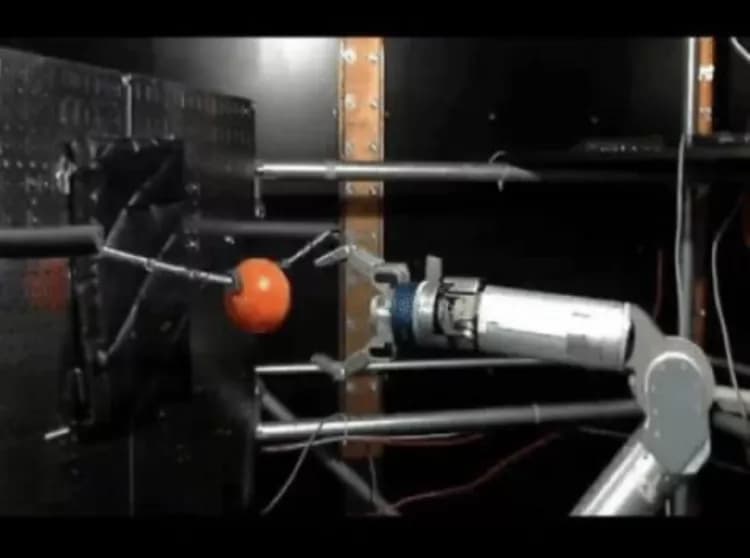
The monkeys were then trained (with generous helpings of juice) to move a robotic arm and grasp a ball using only their thoughts. The scientists recorded the activity of neurons where the electrodes were placed, and used a statistical model to calculate how the neurons were connected to each other before the experiments, during training and once the monkeys mastered the activity.
The connections between neurons on the contralateral side -- the side that had been controlling the amputated arm -- were sparse before the training, most likely because they had not been used for that function in a long time. But as training progressed, these connections became more robust and dense in areas used for both reaching and grasping.
On the ipsilateral side -- the side that had been controlling the monkey's intact arm -- the connections were dense at the beginning of the experiments. But the researchers saw something interesting as training progressed: first the connections were pruned and the networks thinned, before rebuilding into a new, dense network.
"That means connections were shedding off as the animal was trying to learn a new task, because there is already a network controlling some other behavior," said Karthikeyan Balasubramanian, PhD, a postdoctoral researcher who led the study. "But after a few days it started rebuilding into a new network that can control both the intact limb and the neuroprosthetic."
Now the team plans to continue their work by combining it with research by other groups to equip neuroprosthetic limbs with sensory feedback about touch and proprioception, which is the sense of where the limb is located in space.
"That's how we can begin to create truly responsive neuroprosthetic limbs, when people can both move it and get natural sensations through the brain machine interface," Hatsopoulos said.
Materials provided by University of Chicago Medical Center. Note: Content may be edited for style and length.
Disclaimer: DoveMed is not responsible for the accuracy of the adapted version of news releases posted to DoveMed by contributing universities and institutions.
References:
Karthikeyan Balasubramanian, Mukta Vaidya, Joshua Southerland, Islam Badreldin, Ahmed Eleryan, Kazutaka Takahashi, Kai Qian, Marc W. Slutzky, Andrew H. Fagg, Karim Oweiss, Nicholas G. Hatsopoulos. (2017). Changes in cortical network connectivity with long-term brain-machine interface exposure after chronic amputation. Nature Communications. DOI: 10.1038/s41467-017-01909-2

Related Articles
Test Your Knowledge
Asked by users
Related Centers
Related Specialties
Related Physicians
Related Procedures
Related Resources
Join DoveHubs
and connect with fellow professionals
0 Comments
Please log in to post a comment.