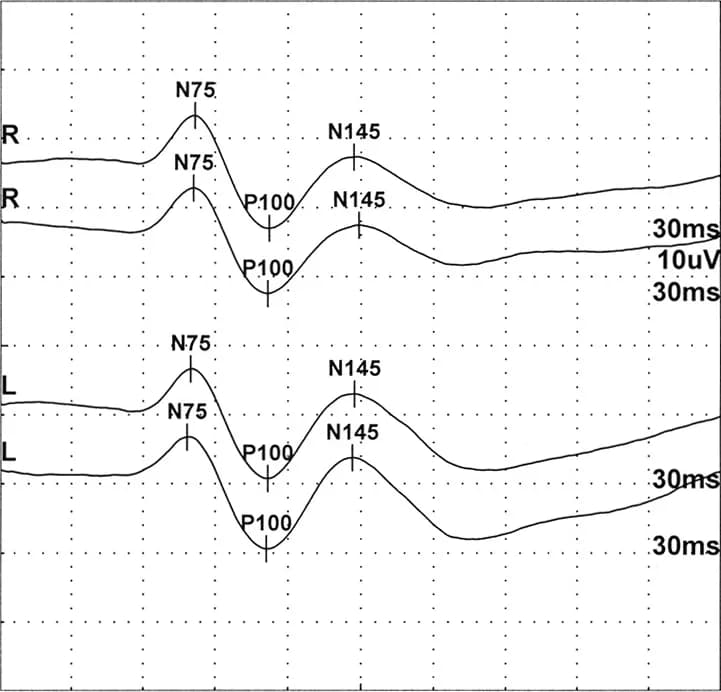
What is Visual Evoked Potential Test?
Visual Evoked Potential (VEP) Test is a non-invasive study of the functioning of the visual pathways starting from the macula and optic nerves to the occipital lobes, which have the vision centers of the brain. It does not detect abnormalities in other eye structures. It measures the conduction along this pathway. VEP Test is very sensitive to abnormalities in the visual pathway to the brain, but not very specific in determining the actual cause of the abnormalities.
Indications for performing Visual Evoked Potential Test include:
- Optic neuritis
- Multiple sclerosis (MS)
- Tumors compressing the optic nerves such as optic nerve gliomas, meningiomas, craniopharyngiomas, pituitary tumors, and others
- Anterior ischemic optic neuropathy
- Toxic amblyopia
- Glaucoma
- Leber’s optic atrophy
How is Visual Evoked Potential Test performed?
- The procedure is performed by presenting a checkerboard pattern to the patient. If visual acuity is reduced, larger sized checks may be needed.
- Age, sex and pupillary size affect the response. So, it is important not to have the pupils dilated for this test
- Only one eye can be stimulated at a time
- The entire process takes about one hour
Patient cooperation is extremely important, since not looking directly at the pattern alters the response. The Visual Evoked Potential Test is therefore not suitable for young kids or adults that are unable to follow these commands. Since sedation and anesthesia eliminate the responses, this test cannot be performed in unconscious patients. Due to this factor, this cannot be used for intraoperative monitoring, unlike somatosensory evoked potential (SSEP) and brainstem auditory evoked potential (BAEP).
The test is interpreted based on whether the abnormalities are unilateral or bilateral (affecting one eye or both eyes). This helps in determining the location of the lesion. The sensitivity of Visual Evoked Potential is superior to that of an MRI study for detection of optic neuritis and multiple sclerosis. It can detect optic nerve lesions before symptoms and signs become apparent, which is useful in the confirmation of early MS where other lesions are present. Also, the results can remain abnormal for years after an episode of optic neuritis. Abnormal responses due to tumors may resolve after surgery. Lesions more proximal than the optic nerve may be better detected by neuroimaging techniques such as an MRI scan.
In summary, the Visual Evoked Potential Test is used to measure the brain’s response to visual stimulus using electrodes placed on one’s scalp. This non-invasive procedure can help evaluate one’s vision health, and is recommended when symptoms, such as blurry vision, double vision, or vision impairment, are noted. VEP Test may help diagnose optic neuritis, lesions affecting the optic nerve, and other causes of vision loss.

Related Articles
Test Your Knowledge
Asked by users
Related Centers
Related Specialties
Related Physicians
Related Procedures
Related Resources
Join DoveHubs
and connect with fellow professionals
0 Comments
Please log in to post a comment.